Innovation as the Driving Force Behind the Intelligent Temperature Control Units of Tomorrow
At Tool-Temp, technological development is a team effort – that’s something we firmly believe in. Since February 2025, Dr. Tammo Zobel has been heading the technical department, working closely with his team to strengthen the integration of mechanics, software, and processes. In this interview, he talks about his first months on the job, new ideas, and how we’re shaping the future of temperature control technology with intelligent systems.
1. Tammo, you've been with Tool-Temp since November 2023 and took over the leadership of the technical department in February 2025. How were your first months in this position?
The first months have clearly shown me that technological progress happens when we collaborate closely across interfaces. As Head of Mechanical Engineering, I had already experienced successful collaboration within the mechanical domain. Now, in my new role leading overall technical development, it has become even more apparent how much potential lies in strategically integrating our expertise across different areas, such as mechanics and software.
However, this potential extends far beyond our tech team. It thrives on close collaboration across the entire company – from production to customer service to procurement. Successful technical development means incorporating knowledge and experience from all departments. In my new position, I've experienced how we can create real value through intensive knowledge exchange and cooperation.
One example is the development of our new pumps: all departments were involved across the entire process – from the first concept through prototyping to series production. The result: a significantly improved product for our customers and, at the same time, a team that has learned much with and from each other and enjoys developing new things and bringing them to market successfully.
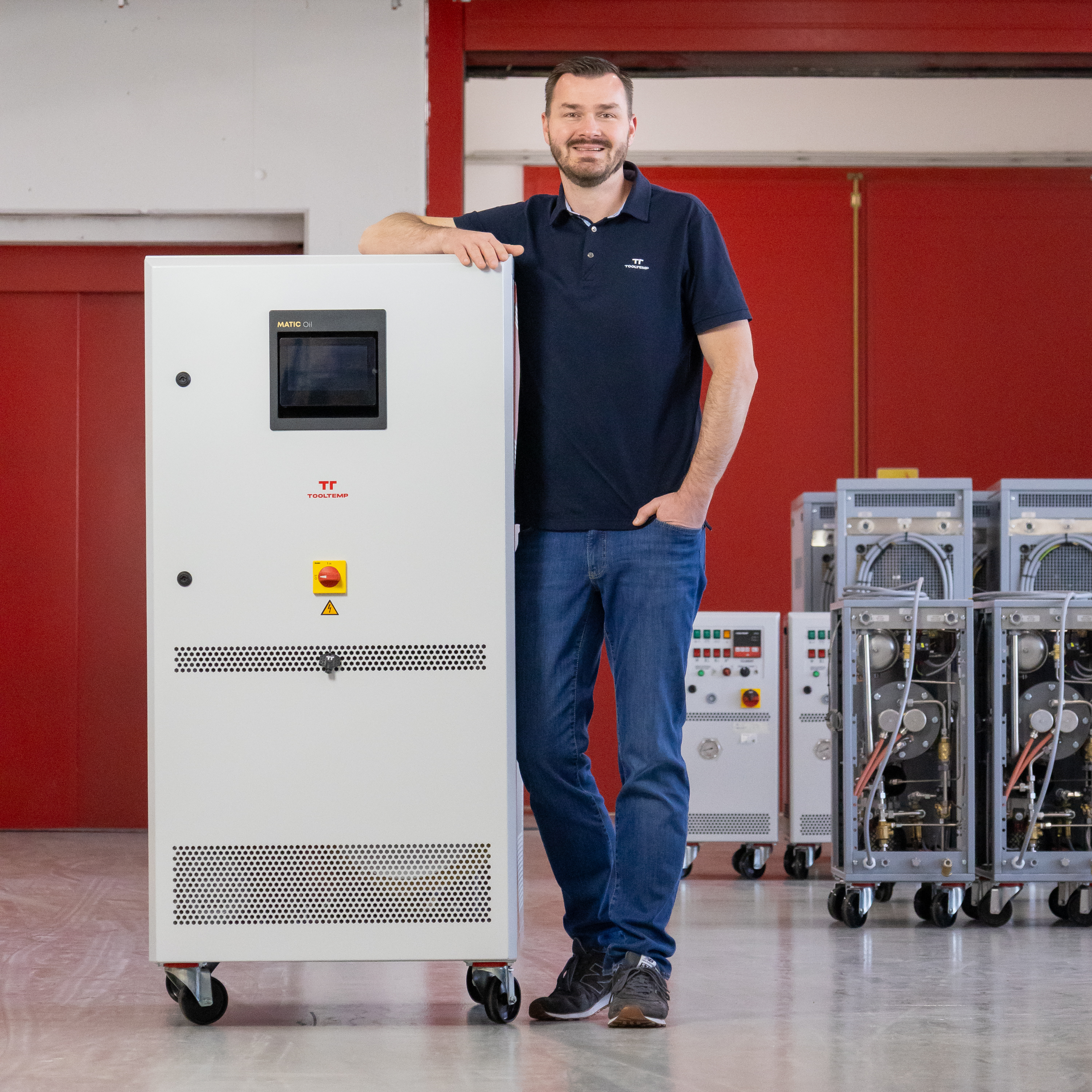 Dr. Tammo Zobel
 2. What tasks and areas of responsibility are associated with your new role?
Technological advancement – through new designs, innovative features, or expanded application areas – are at the core of my tasks. Together with my nine-member, interdisciplinary team, I want to ensure that our products always remain at the technological forefront.
I pay particular attention to interfaces and close collaboration between disciplines – especially the integration of hardware and software. From my research in the automotive sector I learned that software should not be thought of as an add-on, but must be the at the core of development right from the start. For this reason, we developed our own control system IRIS and consistently aligned our strategic focus on software. The future belongs to integrated solutions where mechanical precision and intelligent software seamlessly interlock.
3. Are there specific topics or projects you want to focus on particularly?
I want to drive technological development even further and realize concrete innovations that make our technology and products future-proof in the long term.
For that purpose, I’d like to highlight three main areas. The first area is intelligent process monitoring with predictive control in our temperature control units. Here we're already developing approaches that go significantly beyond today's standards. The second area is the expansion of innovation from products to our processes. For that purpose, I am developing new formats for processing technical information so that both our employees and our customers – through training, videos, or hands-on training – can optimally exploit the opportunities provided by our technical developments. The third area is the contribution to emission reduction through energy efficiency. In our energy-intensive industry, I see enormous potential to understand decarbonization as an innovation opportunity.
4. At ETH Zurich, you earned a doctorate in control engineering. What particularly fascinated you about this field, and what were the main focuses of your research?
Control engineering fascinates me because it makes complex systems with their own dynamics controllable. In my dissertation at ETH Zurich, I developed optimal warm-up strategies for a micro combined heat and power plant – from engineering cold-start strategies for emission reduction to system-wide optimisation of the entire heat-up process. With this, I was able to provide new technical impulses for efficient heating and power supply of buildings, which we successfully demonstrated in real installations together with our industry partners.
I also bring this expertise to Tool-Temp: heating and cooling processes to target temperatures, integration of software, design of mechanical and electronic systems, coupled fluid circuits – I've already worked intensively on all these topics in my research and can now let scientific findings flow into technical development.
5. After your studies, you worked in various areas. Which professional experiences shaped you the most?
What shaped me most was the international and innovative environment of my previous professional positions. After my studies, I first worked at the Institute for Automotive Engineering at RWTH Aachen, where we developed innovative vehicle dynamics control systems and tire simulation models together with industry partners from Germany and abroad. Subsequently, I intensified international collaborations as a Research Specialist at the Hyundai Center of Excellence at the University of California, Berkeley, USA. I worked in an interdisciplinary team of researchers and practitioners from around the world at the forefront of function development for autonomous driving. ETH Zurich – my third station – also offered a highly innovative and international environment for cutting-edge technological research and development.
These experiences showed me how enriching collaboration between people with different backgrounds, expertise, and perspectives is. Therefore, I particularly appreciate the close and successful collaboration at Tool-Temp. My previous work at the interface between scientific research and practical application motivates me to shape innovation as a driving force in technological development.
6. Are there certain topics from your perspective that customers should know more about when it comes to temperature control technology?
Temperature stability is key! Even small fluctuations can lead to significant quality problems in the customer's product. Precise temperature control may look simple at first glance, but it's the result of consistent innovations in sensor technology, control engineering, and fluid mechanics. We've built up decades of expertise to regulate even the smallest fluctuations. We enable our customers to reproduce process parameters with high precision and ensure product quality at a constant level.

7. The requirements for process safety are increasing. What measures does Tool-Temp take to ensure maximum safety and efficiency for customers?
Process safety is a core topic for us. We have therefore integrated comprehensive safety and plausibility checks into our IRIS control system. The system continuously monitors itself and issues hints, warnings, or error messages depending on the severity.
We are especially proud of our intelligent process monitoring. If target values are not reached, the system responds instantly. It also identifies deviations from the expected cooling behavior derived from physical laws and issues appropriate alerts. This gives our customers confidence that any irregularities are recognized immediately.
But safety doesn't end with technology. We place great emphasis on training and education – because even the best safety system is only useful when it's used correctly. Here again, we rely on close collaboration: our experts work directly with operators on-site to explain the technology and deepen understanding of the underlying processes. This is how safety technology becomes true process safety.
8. What role do digitalization and automation play in future product development at Tool-Temp?
It plays an absolutely central role – because our vision is for temperature control units to become intelligent partners in the production process. We are already developing self-learning systems that detect process patterns and optimize themselves automatically. Imagine an IRIS system that learns from every cycle, predicts wear, and continuously refines control parameters – all without manual intervention.
The next step is fully networked production: our devices communicate directly with injection moulding and die-casting machines, analyze production data, and act proactively. When the machine starts a new article, the temperature control unit automatically configures itself for optimal performance. The system identifies relationships between temperature curves and suggests targeted adjustments.
In this way, we reach a new level of cooperation – not only internally between our teams and externally with our customers, but also between the machines themselves.